

Your child wakes up early with an earache on Saturday morning. Your teenager twists an ankle at practice. Maybe you cut your hand working in the garage or your suddenly realize that the UTI symptoms you’ve been trying to ignore are getting worse. This is when you might think, “Should I go to an urgent care or the emergency room?”
For illnesses and injuries that need prompt attention but aren’t life-threatening, an urgent care center can often provide convenient treatment with a shorter visit and significantly lower cost than a hospital emergency department. However, there are situations when skipping urgent care and heading directly to the ER could be lifesaving.
Here’s how to know the difference.
Urgent Care or ER? A Simple Rule to Remember
TIP: If the illness or injury needs attention today but isn’t threatening life, urgent care may be the appropriate place to start. If the condition could be life-threatening or cause permanent harm without immediate treatment, choose the emergency room or call 911.
Urgent care centers are designed to fill the gap between your regular doctor’s office and the emergency room. They treat acute illnesses and injuries that shouldn’t necessarily wait days for an appointment but don’t require the advanced resources of a hospital.
Emergency departments, on the other hand, are equipped and staffed to handle heart attacks, strokes, severe trauma, respiratory emergencies and other potentially life-threatening conditions 24 hours a day.
FACT: Urgent care has become a familiar part of American healthcare. According to a 2026 CDC report using 2024 National Health Interview Survey data, 28.5% of children and 28.9% of adults ages 18–64 had visited an urgent care center during the previous 12 months.
Urgent Care or Emergency Room? A Quick Comparison
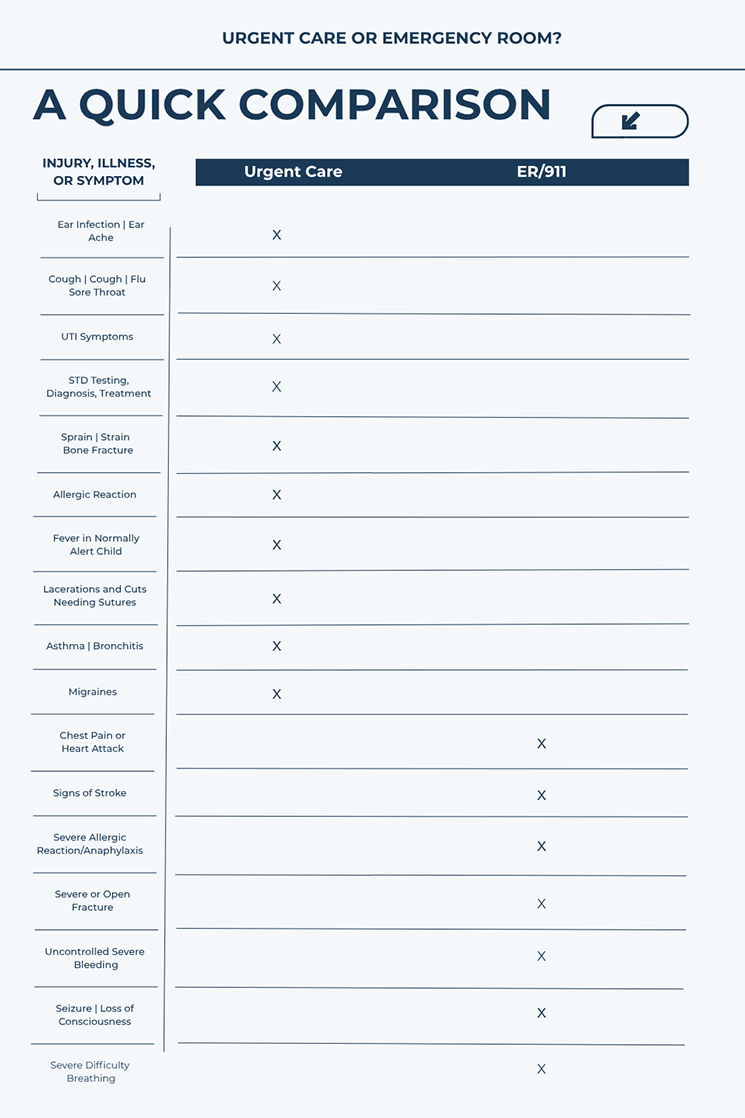
This chart is a general guide, not a diagnosis. Symptoms and individual health circumstances matter. When a condition appears life-threatening, call 911 immediately.
Is Urgent Care Cheaper Than the ER?
For an appropriate non-emergency condition, urgent care can be dramatically less expensive than emergency room care.
Recent UnitedHealthcare data comparing sites of care reported an average combined employer-and-employee cost of approximately $184 for an urgent care visit versus $2,722 for an emergency room visit. Actual costs vary considerably depending on insurance coverage, location, tests, X-rays, medications and the complexity of treatment.
Why such a large difference?
An emergency department must maintain the staff, technology and infrastructure necessary to respond immediately to life-threatening conditions. That capability is essential when you need it, but it also makes emergency care more expensive. A 2024 JAMA Network Open study examining hospital pricing found substantial emergency department facility fees, even before considering all the additional services a patient might require.
The takeaway isn’t to avoid the ER because it costs more. It’s to choose the appropriate level of care. A sprained ankle doesn’t need a trauma center. A suspected heart attack does.
Is Urgent Care Faster Than the ER?
Often, yes, particularly for non-emergency conditions.
Emergency departments use a triage system. The sickest and most seriously injured patients are treated first, regardless of who arrived first. That’s exactly how an ER should operate, but it also means someone arriving with an ear infection, minor cut or sprained wrist could face a substantial wait when the department is treating serious emergencies.
Urgent care centers are specifically designed around non-life-threatening acute illnesses and injuries, which can make them a more convenient option for families and active adults who need same-day attention.
At Heavens Urgent Care in Apache Junction, no appointment is required, and walk-in patients are welcome. Patients can also use online check-in to help make the process more convenient.
BONUS SECTION: When Your Child Is Sick: Don't Judge a Fever by the Number Alone
Few things get a parent’s attention faster than a rising temperature. However, when deciding between urgent care and the ER for a child, the number on the thermometer isn’t the only thing that matters. Consider how your child is breathing, behaving and responding to you, whether they are drinking fluids and urinating normally, and whether other concerning symptoms are present.
A child with a fever who is alert, breathing comfortably and drinking fluids is very different from a child with a similar temperature who is extremely lethargic, struggling to breathe, severely dehydrated, confused, having a seizure or difficult to wake.
For children ages 3–18 with fever, ear infections, sore throats, respiratory infections and many other common illnesses, urgent care may be appropriate when symptoms need prompt attention but don’t appear life-threatening.
If you aren’t sure how serious your child’s condition is, seek professional medical guidance. If your child is having difficulty breathing, becomes unresponsive, has a seizure or appears seriously ill, call 911 or go directly to an emergency department.
Active Families Don't Always Have Time to Wait
Urgent care can also be particularly useful for active adults, athletes and busy families.
A weekend hike can end with a sprained ankle. A youth sporting event can mean an unexpected injury. Yard work can lead to a cut that needs medical attention. These aren’t necessarily emergencies, but waiting several days for a regular doctor’s appointment may not make sense either.
Urgent care provides that middle ground.
Heavens Urgent Care treats many common illnesses and injuries, including sprains and strains, fractures, cuts and lacerations, allergic reactions, asthma and bronchitis, ear infections, migraines, urinary tract infections, and STD diagnosis and treatment, along with many other non-life-threatening conditions.
Should You Go Directly to the ER or Call 911?
Some symptoms should never be delayed because you’re worried about the expense or wait at an emergency room.
Call 911 or seek emergency care for symptoms such as chest pain or suspected heart attack, signs of stroke, severe breathing difficulty, a severe allergic reaction affecting breathing, major trauma, serious head injury, uncontrolled bleeding, loss of consciousness, seizure, severe confusion or another potentially life-threatening condition.
When in doubt about a potentially life-threatening condition, err on the side of emergency care.

Why Families Choose Heavens Urgent Care in Apache Junction
For families throughout Apache Junction and Arizona’s East Valley, having a local healthcare option can make an unexpected illness or injury a little less stressful.
"Between Roxanne checking us and Dr Heavens treating me, this was the best experience . Very professional and courteous staff were able to treat and get us on our way. Very impressed! I would give more stars if that was a choice!"
Tim B.
Heavens Urgent Care is a privately owned practice providing care for children and adults, with walk-in visits and online check-in available. The clinic treats a broad range of illnesses and injuries that require timely medical attention but don’t belong in an emergency department.
There’s another distinction that’s particularly important for some families: Heavens Urgent Care is a Certified Autism Center™.
Staff members receive specialized training to better understand and accommodate autistic and neurodivergent patients, including individuals who may experience communication challenges, medical anxiety or sensory sensitivities. The goal is to create a healthcare experience in which patients and their families feel understood and respected.
That can make a meaningful difference when an already sick or injured child is overwhelmed by an unfamiliar medical environment.
Sick or Injured Today? We're Here When You Need Us
Knowing the difference between urgent care vs. the emergency room can save time, potentially save money and help you get the appropriate level of medical care.
If an illness or injury isn’t life-threatening but needs attention today, Heavens Urgent Care in Apache Junction welcomes walk-in patients seven days a week. You can also use online check-in for added convenience.
If you’re unsure whether your condition is something Heavens Urgent Care treats, call 480-444-1160. For a life-threatening emergency, call 911.

This article is for educational purposes only and is not a substitute for medical advice, diagnosis, or treatment. Intermittent fasting may not be appropriate for everyone, especially people with chronic health conditions, diabetes, or medication-related concerns. If you are thinking about starting a fasting routine, please speak with a qualified medical professional first.